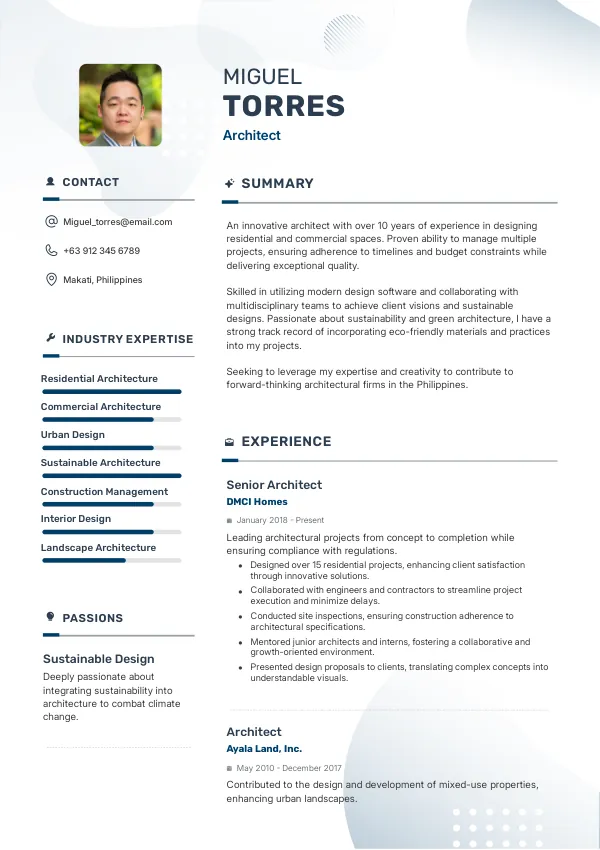
Understanding Architect Resume Mistakes
In the competitive field of architecture in the Philippines, your resume is crucial for securing interviews. Mistakes in your resume can often lead to rejection, even before a recruiter reads through your qualifications. It's essential to review your resume thoroughly to avoid common pitfalls that could hinder your chances.
How Recruiters and ATS Evaluate Architect Resumes
Recruiters look for specific qualifications and experiences when evaluating architect resumes. They often use Applicant Tracking Systems (ATS) to screen resumes for relevant keywords and formats. Many candidates may never realize they are being rejected due to overlooked issues. A professional review can help identify these hidden mistakes so you can improve your document.
Ensure your resume is ATS-compliant to avoid automatic rejections.
Check NowCommon Resume Mistakes for Architects
Mistake #1 – Poor Formatting
Why this hurts
Recruiters expect a clean and professional layout. Cluttered formatting can make it hard to read.
Example
- Bad: Multiple font styles and sizes.
- Better: Consistent font and size throughout.
How to fix
- Use a professional template with clear headings and bullet points.
Mistake #2 – Irrelevant Information
Why this hurts
Including unrelated experiences can dilute your qualifications and confuse recruiters.
Example
- Bad: Listing unrelated job experiences.
- Better: Focus on relevant architecture projects and internships.
How to fix
- Tailor your resume to highlight experiences relevant to the architect role.
Mistake #3 – Generic Objective Statements
Why this hurts
Generic statements do not capture the recruiter’s interest and can make you seem less committed.
Example
- Bad: “Looking for a challenging position.”
- Better: “Aspiring architect with a passion for sustainable design.”
How to fix
- Write a specific objective that reflects your career goals and the company's values.
Mistake #4 – Ignoring ATS Keywords
Why this hurts
Failing to include relevant keywords can lead to automatic rejection by ATS.
Example
- Bad: Using vague terms like “designing.”
- Better: Incorporating specific skills like “AutoCAD,” “3D modeling,” or “project management.”
How to fix
- Analyze the job description for keywords and include them in your resume.
Mistake #5 – Lack of Quantifiable Achievements
Why this hurts
Not showcasing achievements can make your resume less impactful.
Example
- Bad: “Worked on several projects.”
- Better: “Led a team to complete five architectural designs ahead of schedule.”
How to fix
- Include numbers and results to demonstrate your contributions.
Mistake #6 – Inconsistent Job Titles
Why this hurts
Inconsistent titles can raise red flags about your experience and credibility.
Example
- Bad: “Intern” on one part and “Architect Assistant” on another.
- Better: Stick to one title that accurately reflects your role.
How to fix
- Use one consistent title across all your experiences.
Mistake #7 – Spelling and Grammar Errors
Why this hurts
Errors can signal a lack of attention to detail, which is crucial in architecture.
Example
- Bad: “Managed a project that was succesful.”
- Better: “Managed a project that was successful.”
How to fix
- Proofread your resume multiple times and consider using tools for grammar checks.
Mistake #8 – Not Tailoring for Each Application
Why this hurts
Sending the same resume to multiple employers can make you appear uninterested.
Example
- Bad: Generic resume sent to every job application.
- Better: Customized resume for each application highlighting specific skills.
How to fix
- Adapt your resume to align with each job description you apply for.

ATS Issues That Could Affect Your Resume
ATS often struggles with complex formatting and non-standard file types, leading to important information being missed. Resumes in unusual formats may not be parsed correctly, which can result in critical keywords being overlooked. It's hard to self-diagnose these ATS-related issues without an automated or expert review, making it advisable to check your resume with mistakes.cv for compatibility.
Mistakes by Experience Level
Entry-level
Entry-level architects often struggle with showcasing relevant experience. Emphasizing internships and projects is vital. Highlight your education and any volunteer work relevant to architecture.
Mid-level
Mid-level professionals should focus on leadership roles and measurable achievements. Avoid vague descriptions, and instead, detail specific projects you've led or contributed to.
Senior/Lead
Senior architects need to communicate strategic vision and mentorship. Highlight your ability to lead projects and teams effectively. Use your resume to showcase your influence on project outcomes.
Get expert insights to perfect your resume before applying.
Review ResumeQuick Checklist for Your Architect Resume
- Use a clear and professional format.
- Tailor your resume for each application.
- Incorporate relevant keywords from job descriptions.
- Quantify your achievements.
- Proofread for spelling and grammar errors.
- Be consistent with job titles.
- Avoid irrelevant information.
- Craft a specific objective statement.
- Ensure ATS compatibility by using standard file types.
- Review your resume with a professional service like mistakes.cv.
Frequently Asked Questions
What should I include in my architect resume?
Focus on relevant experience, skills, and achievements in architecture. Tailor your resume to the job description.
How important is ATS for my resume?
ATS is crucial for filtering applications. Ensuring your resume meets ATS criteria increases your chances of getting noticed.
Can I use a creative format for my resume?
While creativity can be beneficial, ensure it remains professional and ATS-friendly. Stick to standard formats for best results.
How do I make my resume stand out?
Highlight quantifiable achievements and tailor your resume for each application to demonstrate your fit for the role.
Should I get my resume reviewed?
Absolutely! A professional review can help identify mistakes and improve your chances significantly.
Take Action on Your Architect Resume Today
Your architect resume needs to reflect your skills and experiences effectively. Don't leave your chances to chance; review and improve your resume to stand out to recruiters.
Consider getting a second opinion on your resume with mistakes.cv to ensure you’re putting your best foot forward in your job applications.

 UAE
UAE Qatar
Qatar Saudi Arabia
 South Africa
 Brazil
 USA
USA Canada
 Australia
 United Kingdom
 New Zealand
 Singapore
 Germany
 France
 Spain
Spain Greece
 Italy
Italy India
India Philippines
 Malaysia
 Indonesia
 South Korea
 Japan
Japan