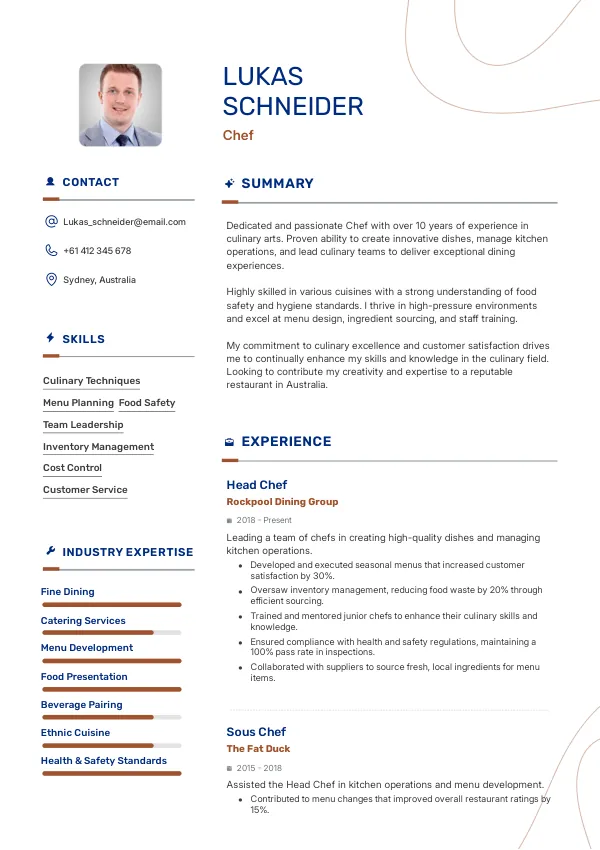
Understanding Chef Resume Mistakes in Australia
As a chef in Australia, the culinary job market is competitive. Your resume must stand out to catch the attention of recruiters. Common mistakes can lead to missed opportunities, resulting in numerous rejections. To avoid this, consider reviewing your resume to identify any hidden errors that might be holding you back.
How Recruiters and ATS Evaluate Chef Resumes
Recruiters and ATS systems are looking for specific keywords and relevant experience when evaluating chef resumes. Many candidates are often rejected due to overlooked formatting issues or lack of keyword alignment. An external review can help you pinpoint these unnoticed problems, increasing your chances of landing an interview.
Understanding how to craft your resume with ATS in mind can significantly boost its effectiveness in getting past initial screenings.
Enhance your resume to attract more job offers.
Review NowCommon Chef Resume Mistakes
Mistake #1 – Poor Formatting
Why this hurts
Inconsistent formatting can confuse recruiters and make your resume difficult to read. A cluttered layout often leads to important information being overlooked.
Example
- Bad: Using varied fonts and sizes throughout the resume.
- Better: Maintain uniform font style and size for headings and body text.
How to fix
- Choose a clean, professional template and stick to a consistent format.
Mistake #2 – Irrelevant Information
Why this hurts
Including unrelated work experience can dilute the impact of your culinary skills. Recruiters want to see relevant experience that aligns with the job description.
Example
- Bad: Listing every job you've ever had, including unrelated fields.
- Better: Focus on culinary roles and highlight relevant experience.
How to fix
- Tailor your resume to reflect only relevant culinary positions and skills.
Mistake #3 – Lack of Keywords
Why this hurts
ATS systems filter resumes based on specific keywords related to the job. Missing these keywords can lead to automatic disqualification.
Example
- Bad: Describing experience without using key industry terms.
- Better: Include terms like 'menu development', 'food safety', and 'catering'.
How to fix
- Review job postings for keywords and incorporate them naturally into your resume.
Mistake #4 – Weak Experience Descriptions
Why this hurts
Vague descriptions fail to convey the depth of your experience. Recruiters need specific examples of your abilities and achievements.
Example
- Bad: "Worked in a restaurant."
- Better: "Led a team of 5 in a high-volume kitchen, improving service speed by 20%."
How to fix
- Use action verbs and quantify your achievements for greater impact.
Mistake #5 – Ignoring Seniority Signals
Why this hurts
Failing to indicate your level of experience can confuse recruiters regarding your suitability for the role.
Example
- Bad: "Worked as a chef."
- Better: "Sous Chef with 5 years of experience in fine dining."
How to fix
- Clearly state your job titles and years of experience to signal your level.
Mistake #6 – Overloading with Jargon
Why this hurts
While culinary terminology is important, excessive jargon can alienate recruiters who may not be familiar with every term.
Example
- Bad: "Expert in sous-vide techniques and molecular gastronomy."
- Better: "Skilled in advanced cooking techniques including sous-vide, aimed at enhancing flavors."
How to fix
- Use clear language that balances professionalism with accessibility.
Mistake #7 – Not Customizing for Each Job Application
Why this hurts
Sending the same resume for every application can lead to missed opportunities. Tailoring your resume shows your genuine interest in the position.
Example
- Bad: A generic resume sent to all restaurants.
- Better: A customized resume highlighting specific skills relevant to the job.
How to fix
- Adjust your resume to reflect the specific requirements and preferences of each role.
Mistake #8 – Missing Contact Information
Why this hurts
If recruiters cannot easily find your contact details, they may move on to the next candidate.
Example
- Bad: Omitting a phone number or email address.
- Better: Clearly list your phone number and email at the top of the resume.
How to fix
- Ensure your contact information is prominently displayed and accurate.
Common ATS-Specific Issues
ATS software often struggles with complex formatting, making it essential to use standard fonts and structures. Many candidates unknowingly submit resumes that ATS cannot parse correctly, resulting in missed opportunities. To avoid this, ensure your resume is in a compatible format like .docx or .pdf and that you use simple formatting. An ATS review could clarify these technical issues.
Mistakes Varying by Experience Level
Entry-Level
Entry-level chefs often overlook the importance of internships or volunteer work. Highlight any relevant kitchen experience, even if unpaid, to show your commitment and skill development.
Mid-Level
Mid-level chefs should focus on leadership skills and achievements in their roles. Emphasize any team management or training experience to showcase your growth.
Senior
Senior chefs must demonstrate strategic thinking and innovation. Include details about menu development, cost management, or unique culinary projects to show your impact.
Identify and fix ATS issues effortlessly.
Check ATSQuick Checklist Before You Apply
- Use a clean, consistent format.
- Include relevant keywords from the job description.
- Highlight achievements with quantifiable results.
- Clearly indicate your job titles and experience levels.
- Customize your resume for each application.
- Ensure your contact information is accurate and visible.
- Avoid excessive jargon.
- Limit unrelated work experience.
- Check for ATS compatibility.
- Review your resume with a professional for hidden errors.
Frequently Asked Questions
What should I include in my chef resume?
Focus on relevant culinary experience, skills, and achievements. Tailor your resume to each job application.
How can I make my resume stand out?
Use clear formatting, relevant keywords, and highlight specific achievements to catch a recruiter's eye.
Is it necessary to use culinary jargon in my resume?
While some terminology is helpful, ensure that your language is accessible to all readers, including non-culinary recruiters.
How often should I update my resume?
Regularly update your resume with new skills and experiences, especially when applying for new positions.
Can a resume review really help me?
Yes, a professional review can identify hidden mistakes and improve your chances of landing interviews.
Take Action on Your Resume Today
Don't let resume mistakes keep you from the culinary career you desire. Review your chef resume for common errors and enhance your chances of success.
Consider using mistakes.cv for a professional review and ensure your resume is polished and ready for your next application.

 UAE
UAE Qatar
Qatar Saudi Arabia
 South Africa
 Brazil
 USA
USA Canada
 Australia
 United Kingdom
 New Zealand
 Singapore
 Germany
 France
 Spain
Spain Greece
 Italy
Italy India
India Philippines
 Malaysia
 Indonesia
 South Korea
 Japan
Japan