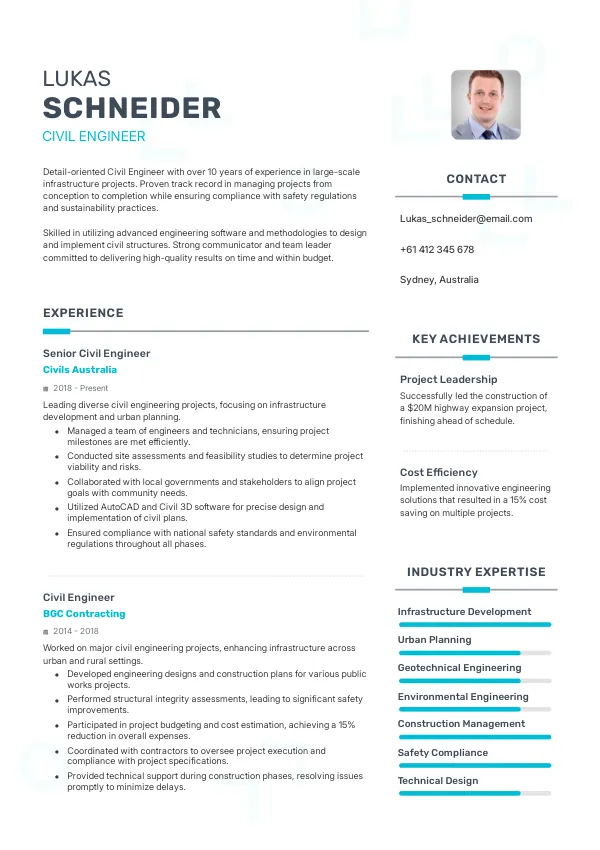
Common Resume Pitfalls for Civil Engineers in Australia
As a civil engineer in Australia, crafting an effective resume is crucial for securing interviews. Many candidates unknowingly make mistakes that can hinder their chances of being noticed by recruiters. Regularly reviewing your resume can help you avoid these pitfalls and improve your application outcomes.
How Recruiters Evaluate Civil Engineer Resumes
Recruiters and hiring managers in Australia evaluate resumes through both manual reviews and Applicant Tracking Systems (ATS). These systems scan for specific keywords and formatting that signal relevance to the role. Unfortunately, many candidates miss out on opportunities due to unnoticed errors that could easily be fixed with an external review from services like mistakes.cv.
Understanding how your resume is evaluated can help you highlight your strengths and align your skills with what employers are seeking.
Ensure your resume is error-free and ATS compliant.
Review NowCommon Resume Mistakes for Civil Engineers
Mistake #1 – Poor Formatting
Why this hurts
A cluttered or inconsistent format makes it difficult for recruiters to quickly assess your qualifications. It can lead to immediate rejection.
Example
- Bad: Using multiple font styles and sizes throughout the resume.
- Better: Maintaining a uniform font style and size for a clean look.
How to fix
- Choose a professional font and stick to it. Use headings and bullet points for clarity.
Mistake #2 – Lack of Relevant Keywords
Why this hurts
Recruiters use specific keywords to find the right candidates. If these keywords are missing, your resume may not get past the ATS.
Example
- Bad: General phrases like 'good team player.'
- Better: Specific skills such as 'project management' or 'structural analysis.'
How to fix
- Incorporate keywords from the job description directly into your resume.
Mistake #3 – Irrelevant Experience
Why this hurts
Including unrelated work experience can dilute your qualifications. Recruiters prefer focused resumes that showcase relevant skills.
Example
- Bad: Listing a part-time job unrelated to engineering.
- Better: Highlighting internships or projects relevant to civil engineering.
How to fix
- Tailor your resume for each application, emphasizing relevant roles and experiences.
Mistake #4 – Weak Action Verbs
Why this hurts
Using weak verbs can undermine your achievements. Strong action verbs convey confidence and capability.
Example
- Bad: 'Was responsible for managing projects.'
- Better: 'Led project management for high-profile engineering projects.'
How to fix
- Use dynamic verbs like 'developed,' 'engineered,' and 'implemented' to showcase your contributions.
Mistake #5 – Lack of Metrics
Why this hurts
Without metrics, accomplishments can seem vague. Quantifying achievements provides concrete evidence of your impact.
Example
- Bad: 'Improved efficiency.'
- Better: 'Improved project efficiency by 20% through innovative design.'
How to fix
- Include metrics such as percentages, dollar amounts, or timelines to quantify your successes.
Mistake #6 – Not Tailoring to the Job Description
Why this hurts
A generic resume may fail to capture the attention of recruiters. Customization is key to demonstrating your fit for the role.
Example
- Bad: Sending the same resume for every application.
- Better: Adjusting your resume to match the specific requirements of each position.
How to fix
- Review the job description carefully and ensure your resume addresses the key qualifications and skills.
Mistake #7 – Failing to Highlight Certifications
Why this hurts
In the engineering field, certifications can be a differentiator. Not showcasing them can make you less competitive.
Example
- Bad: Not mentioning relevant certifications.
- Better: Clearly listing certifications such as 'Chartered Engineer' or 'Project Management Professional.'
How to fix
- Dedicate a section to certifications and licenses, ensuring they are easily visible.
Mistake #8 – Overly Long Resumes
Why this hurts
Long resumes can deter recruiters. Most prefer concise documents that highlight key information.
Example
- Bad: A three-page resume.
- Better: A focused, two-page resume.
How to fix
- Keep your resume to two pages, focusing on the most relevant information.
Key ATS Issues for Civil Engineer Resumes
Applicant Tracking Systems (ATS) can inadvertently filter out resumes that do not meet certain criteria. Common problems include incorrect file formats, excessive graphics, and lack of proper headings. These errors can be difficult to identify without an automated review. Consider using mistakes.cv to uncover hidden ATS issues in your resume.
Mistakes by Experience Level
Entry-Level
Entry-level civil engineers often overlook internships or relevant coursework. Ensure you emphasize projects and any practical experience that aligns with the job description.
Mid-Level
Mid-level engineers should focus on leadership roles. Highlighting project management experience can set you apart from other candidates.
Senior/Lead
Senior engineers must demonstrate strategic thinking and major project successes. Be explicit about your contributions to high-impact projects and leadership roles.
Get expert insights tailored to your civil engineering career.
Get HelpQuick Checklist Before Submitting Your Resume
- Ensure uniform formatting throughout.
- Incorporate relevant keywords from the job description.
- Highlight only relevant work experience.
- Use strong action verbs.
- Quantify achievements with metrics.
- Customize your resume for each application.
- List your certifications prominently.
- Keep your resume concise, ideally two pages.
- Check for ATS compatibility.
- Review for spelling and grammatical errors.
FAQs About Civil Engineer Resumes in Australia
What should I include in my civil engineer resume?
Focus on relevant education, certifications, and practical experience in engineering projects.
How long should my resume be?
Ideally, keep it to two pages to maintain recruiter interest.
Is it necessary to customize my resume for each job?
Yes, tailoring your resume for each application increases your chances of being noticed.
What common mistakes should I avoid?
Avoid poor formatting, irrelevant experience, and vague descriptions of your accomplishments.
How can I improve my resume's chances with ATS?
Use standard file formats, avoid excessive graphics, and include relevant keywords.
Take Action on Your Resume Today
Don't let your resume hold you back from landing your dream civil engineering position. Review and enhance your resume using mistakes.cv to ensure you're presenting your best self to recruiters.
Consider scheduling a professional review to identify and fix any hidden mistakes that could cost you interviews.

 UAE
UAE Qatar
Qatar Saudi Arabia
 South Africa
 Brazil
 USA
USA Canada
 Australia
 United Kingdom
 New Zealand
 Singapore
 Germany
 France
 Spain
Spain Greece
 Italy
Italy India
India Philippines
 Malaysia
 Indonesia
 South Korea
 Japan
Japan