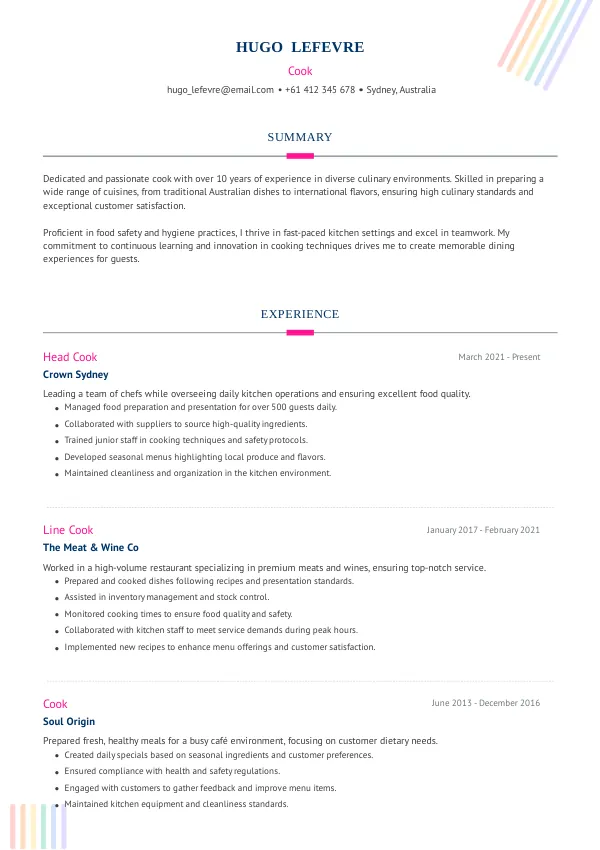
Resume Mistakes That Block Cooks from Getting Interviews
As a cook in Australia, your resume is a crucial tool in landing interviews. Many skilled cooks face rejection due to common resume mistakes that can be easily fixed. Understanding these pitfalls can open the door to more opportunities. To improve your chances, consider reviewing your resume or CV to catch mistakes early on.
How Recruiters Evaluate Cook Resumes in Australia
Recruiters in the culinary field assess resumes based on clarity, relevant experience, and specific skills. Many candidates are often unaware of the subtle issues that lead to rejection. An external review can help you identify these overlooked mistakes, making your resume more appealing to hiring managers.
Remember, a well-structured resume is essential in a competitive cooking job market, especially when many applicants are vying for the same position.
Get a professional review of your resume to catch hidden mistakes.
Review NowCommon Resume Mistakes for Cooks
Mistake #1 – Poor Formatting
Why this hurts
Poor formatting can make your resume difficult to read and unprofessional. Recruiters skim through resumes quickly, and if they can’t find essential information at a glance, you risk being overlooked.
Example
- Bad: An unaligned layout with inconsistent fonts.
- Better: A clean, consistent format with clear headings.
How to fix
- Use a simple, professional layout with uniform font sizes and styles.
- Ensure sections are clearly defined for easy navigation.
Mistake #2 – Lack of Relevant Keywords
Why this hurts
Many resumes don’t include job-specific keywords, which can lead to rejection during ATS screening. Recruiters often use specific terms to filter candidates.
Example
- Bad: "I worked in a kitchen."
- Better: "Managed a high-volume kitchen, preparing and plating dishes efficiently."
How to fix
- Incorporate industry-specific keywords like "food safety," "menu planning," and "culinary techniques."
Mistake #3 – Generic Job Descriptions
Why this hurts
Generic descriptions fail to highlight your unique contributions and skills. This can make your resume blend in with others, reducing your chances of getting noticed.
Example
- Bad: "Helped in the kitchen."
- Better: "Designed weekly specials that increased sales by 20%."
How to fix
- Tailor your job descriptions to reflect your specific achievements and contributions.
Mistake #4 – Spelling and Grammar Errors
Why this hurts
Typos and grammatical mistakes signal a lack of attention to detail, which is critical in the culinary field. Recruiters may question your professionalism due to these errors.
Example
- Bad: "Experiance in fast paced enviroment."
- Better: "Experience in fast-paced environments."
How to fix
- Proofread your resume multiple times and consider using tools or services to catch errors.
Mistake #5 – Omitting Certifications
Why this hurts
Failure to list relevant certifications can lead to disqualification. Many employers look for specific qualifications when hiring cooks.
Example
- Bad: Not mentioning food safety certification.
- Better: "Certified in Food Safety and Hygiene, 2023."
How to fix
- Clearly list all relevant certifications in a dedicated section.
Mistake #6 – Ignoring Soft Skills
Why this hurts
Cooks need more than technical skills; soft skills like teamwork and communication are vital. Ignoring these can make you seem one-dimensional.
Example
- Bad: "I can cook."
- Better: "Excellent team player with strong communication skills."
How to fix
- Highlight both your technical and soft skills relevant to the role.
Mistake #7 – Failing to Quantify Achievements
Why this hurts
Quoting figures or outcomes provides concrete evidence of your skills, which can set you apart. Without this, your resume may lack impact.
Example
- Bad: "Helped manage kitchen operations."
- Better: "Oversaw kitchen operations serving 200+ meals daily."
How to fix
- Include numbers where possible to illustrate your contributions.
Mistake #8 – Not Tailoring Your Resume
Why this hurts
A generic resume fails to address the specific needs of different employers. Tailoring can significantly enhance your chances of getting noticed.
Example
- Bad: Using the same resume for every application.
- Better: Customizing your resume to reflect the specific job description.
How to fix
- Adjust your resume for each job application to align with the job description.
Common ATS Issues for Cook Resumes
Applicant Tracking Systems (ATS) filter resumes based on keywords and formatting. Many cooks unknowingly submit resumes that ATS cannot parse correctly, leading to automatic rejection. Common issues include using headers or footers, unconventional file types, and excessive graphics. These mistakes are hard to self-diagnose without an expert review, and you may miss out on opportunities as a result.
Mistakes by Experience Level
Entry-Level
Entry-level cooks often fail to showcase relevant skills gained during training or internships. Instead of focusing solely on education, highlight practical experiences that demonstrate your readiness for the job.
Mid-Level
Mid-level cooks should avoid vague descriptions of their roles. Instead, emphasize leadership abilities and specific achievements that indicate readiness for more responsibility.
Senior / Lead
Senior cooks must clearly communicate their management experience and strategic contributions. Failing to do so can undermine the perception of their capability to lead a kitchen.
Ensure your resume is ATS-friendly and increases your interview chances.
Check ATSQuick Checklist for Your Cook Resume
- Ensure uniform formatting throughout.
- Incorporate relevant keywords from the job description.
- Highlight specific achievements with quantifiable outcomes.
- Proofread for spelling and grammar errors.
- List relevant certifications prominently.
- Include both technical and soft skills.
- Customize your resume for each application.
- Avoid graphics and images that may confuse ATS.
- Use a standard file type, like PDF or Word.
- Keep your resume to two pages maximum.
Frequently Asked Questions
What should I include in my cook resume?
Include relevant experience, skills, certifications, and achievements specific to the culinary field.
How long should my resume be?
Your resume should ideally be one to two pages, depending on your experience level.
Is it necessary to tailor my resume for each job?
Yes, tailoring your resume increases your chances of passing ATS filters and impressing recruiters.
How can I ensure my resume is ATS-friendly?
Use standard formatting, avoid images, and include relevant keywords from the job description.
Can I get help reviewing my resume?
Yes, using a service like mistakes.cv can provide insights and help you identify any overlooked mistakes.
Take Action: Review Your Cook Resume Today
Improving your resume is an essential step towards securing your next cooking job. Don’t leave your success to chance; take the time to review and enhance your resume or CV.
Consider using mistakes.cv for a professional evaluation to ensure your resume meets industry standards and stands out to recruiters.

 UAE
UAE Qatar
Qatar Saudi Arabia
 South Africa
 Brazil
 USA
USA Canada
 Australia
 United Kingdom
 New Zealand
 Singapore
 Germany
 France
 Spain
Spain Greece
 Italy
Italy India
India Philippines
 Malaysia
 Indonesia
 South Korea
 Japan
Japan