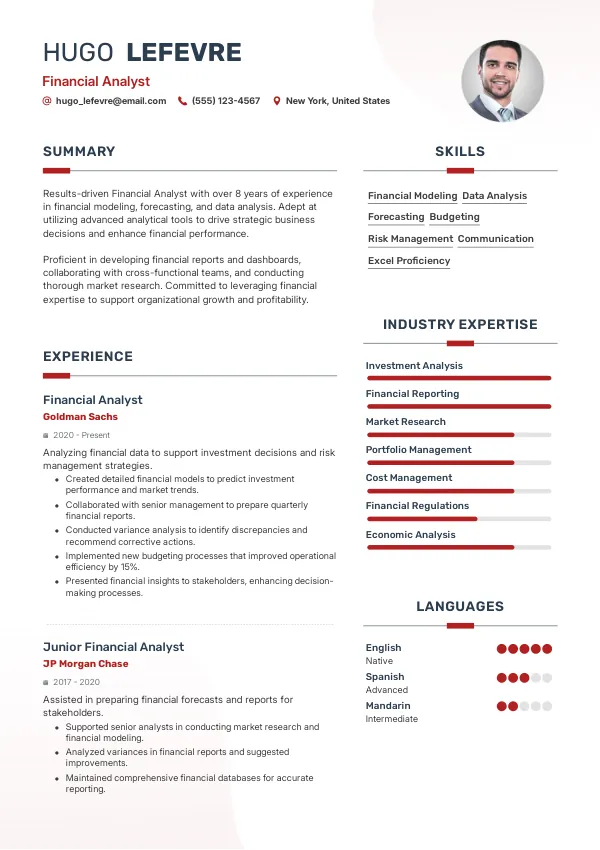
Introduction to Financial Analyst Resumes
As a Financial Analyst, your resume is your first chance to impress potential employers. Many candidates fall into common pitfalls that can reduce their chances of landing an interview. Understanding these mistakes and rectifying them is crucial for standing out in a competitive job market. Consider checking your resume with mistakes.cv to identify any overlooked errors early in your job search.
How Recruiters Evaluate Financial Analyst Resumes
Recruiters and ATS systems assess resumes based on specific criteria relevant to the Financial Analyst role. They often reject applications due to formatting issues, lack of relevant keywords, or poorly structured content. Many candidates are unaware of these issues, which is why a professional review can be beneficial to catch mistakes before submitting your application.
Understanding how your resume is parsed by ATS and evaluated by recruiters can help you tailor your document effectively for the Financial Analyst position.
Ensure your resume stands out with a professional review.
Review NowCommon Resume Mistakes for Financial Analysts
Mistake #1 – Poor Formatting
Why this hurts
Inconsistent formatting can make your resume difficult to read, causing recruiters to overlook key information. ATS systems may also misinterpret poorly formatted resumes, leading to automatic rejections.
Example
- Bad: Mixed font sizes and styles throughout the document.
- Better: Consistent use of font and size, clear headings, and uniform bullet points.
How to fix
- Use a clean, professional font and keep formatting consistent throughout.
- Ensure uniformity in bullet points, headings, and spacing.
Mistake #2 – Lack of Relevant Keywords
Why this hurts
ATS systems look for specific keywords related to the Financial Analyst role. Missing these keywords can result in your resume not being shortlisted.
Example
- Bad: Generic phrases like “good with numbers.”
- Better: Specific keywords like “financial modeling,” “data analysis,” and “budget forecasting.”
How to fix
- Review job descriptions for relevant keywords and incorporate them into your resume.
Mistake #3 – Vague Job Descriptions
Why this hurts
Describing your previous roles without specifics can leave recruiters unconvinced of your capabilities. They want to see measurable accomplishments relevant to the Financial Analyst position.
Example
- Bad: “Responsible for preparing reports.”
- Better: “Prepared monthly financial reports that improved decision-making processes by 20%.”
How to fix
- Quantify your achievements and be specific about your contributions.
Mistake #4 – Ignoring the Summary Section
Why this hurts
A weak summary can fail to capture the recruiter’s attention. This section should summarize your qualifications and make a strong impression.
Example
- Bad: “I am a Financial Analyst.”
- Better: “Detail-oriented Financial Analyst with over 5 years of experience in data analysis and financial modeling, seeking to leverage expertise in a dynamic organization.”
How to fix
- Craft a compelling summary that highlights your experience and skills relevant to the job.
Mistake #5 – Not Tailoring the Resume
Why this hurts
Using a generic resume for multiple applications can lead to missed opportunities. Tailoring your resume shows you’re genuinely interested in the specific position.
Example
- Bad: A resume used for various job applications without changes.
- Better: A resume customized for each Financial Analyst job application, reflecting the specific requirements.
How to fix
- Adjust your resume for each job application by highlighting the most relevant skills and experiences.
Mistake #6 – Overloading with Jargon
Why this hurts
While industry-specific terms are important, overloading your resume with jargon can make it hard to read and understand.
Example
- Bad: “Utilized quantitative easing protocols to optimize fiscal strategies.”
- Better: “Used data-driven analysis to improve financial strategies.”
How to fix
- Be clear and concise. Use jargon sparingly and ensure it’s relevant to the position.
Mistake #7 – Including Irrelevant Work Experience
Why this hurts
Including unrelated job experiences can distract from your qualifications and reduce your resume’s impact.
Example
- Bad: “Worked as a barista for two years.”
- Better: “Focused on financial data analysis in internships relevant to the Financial Analyst role.”
How to fix
- Only include work experience that is relevant to Financial Analysis to maintain focus on your qualifications.
Mistake #8 – Ignoring Soft Skills
Why this hurts
Many candidates focus solely on technical skills, neglecting the importance of soft skills like communication and teamwork.
Example
- Bad: “Expert in Excel.”
- Better: “Strong analytical skills complemented by effective communication for presenting financial findings.”
How to fix
- Highlight a balance of both hard and soft skills relevant to the Financial Analyst role.


ATS-Specific Resume Issues
ATS systems can misinterpret resumes based on file structure and formatting. Common issues include using non-standard fonts, images, or tables that ATS cannot read. These mistakes can lead to your resume being filtered out before a recruiter even sees it.
Identifying and fixing ATS-related errors is challenging without an automated or expert review. Consider utilizing mistakes.cv to analyze your resume for ATS compatibility.
Resume Mistakes by Experience Level
Entry-Level
Entry-level candidates often struggle with demonstrating relevant experience. They may not highlight internships or academic projects that showcase their analytical skills. It’s crucial to present any relevant coursework or projects effectively.
Mid-Level
Mid-level candidates should focus on demonstrating career progression and impact in previous roles. Common mistakes include vague achievements and lack of specific metrics to showcase success.
Senior / Lead
Senior-level candidates should emphasize leadership skills and strategic contributions. Mistakes at this level often involve underplaying their managerial experience or failing to demonstrate their impact on financial outcomes.
Identify hidden mistakes and improve your application.
Get InsightsQuick Checklist for Financial Analyst Resumes
- Ensure consistent formatting throughout the resume.
- Incorporate relevant keywords for the Financial Analyst role.
- Quantify achievements and be specific about past roles.
- Craft a compelling summary that highlights key qualifications.
- Tailor your resume for each specific job application.
- Avoid excessive jargon; keep language clear and concise.
- Include only relevant work experiences.
- Balance technical and soft skills in your presentation.
- Check for ATS compatibility using appropriate file formats.
- Review your resume for any overlooked errors with mistakes.cv.
Frequently Asked Questions
What should I include in my Financial Analyst resume?
Focus on relevant skills, experiences, and achievements that align with the Financial Analyst role.
How can I make my resume stand out?
Tailor your resume to each job application and highlight measurable achievements.
What format should my resume be in?
Use a clean, professional format, and save your resume as a PDF for ATS compatibility.
How long should my resume be?
Keep your resume to one page if you're entry-level and up to two pages for more experienced candidates.
Can mistakes.cv help with my resume?
Yes, mistakes.cv offers detailed reviews to identify and correct common errors in your resume.
Take Action to Improve Your Resume
Don’t let common resume mistakes hold you back from landing interviews as a Financial Analyst. Review your resume for errors, improve its content, and ensure it meets industry standards.
Consider using mistakes.cv for a professional review and gain insights that can enhance your chances of success in your job applications.

 UAE
UAE Qatar
Qatar Saudi Arabia
 South Africa
 Brazil
 USA
USA Canada
 Australia
 United Kingdom
 New Zealand
 Singapore
 Germany
 France
 Spain
Spain Greece
 Italy
Italy India
India Philippines
 Malaysia
 Indonesia
 South Korea
 Japan
Japan