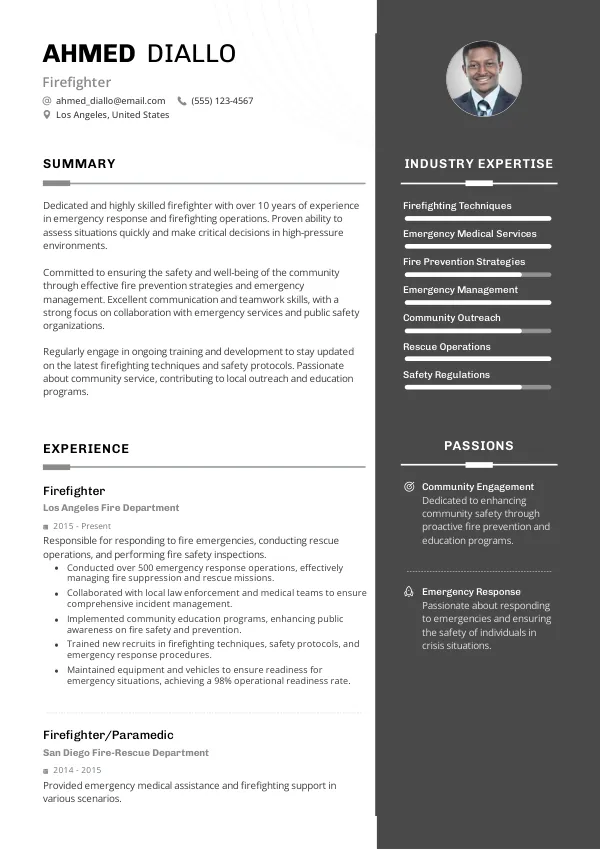
Understanding Firefighter Resume Mistakes
As a firefighter, your resume must reflect your skills, experience, and dedication to public safety. However, many applicants make critical mistakes that can hinder their chances of getting an interview. It's essential to review your resume thoroughly to avoid these pitfalls and improve your prospects in this competitive field.
How Recruiters Evaluate Firefighter Resumes
Recruiters and hiring managers look for specific qualifications and experiences when evaluating firefighter resumes. They often use Applicant Tracking Systems (ATS) to filter candidates based on relevant keywords and formatting. Many candidates are unaware of the issues that can lead to automatic rejection, which is why an external review can be invaluable.
Taking the time to have your resume assessed can help you identify hidden mistakes that could be costing you interviews.
Get a professional review of your firefighter resume to stand out.
Review NowCommon Firefighter Resume Mistakes
Mistake #1 – Poor Formatting
Why this hurts
Recruiters spend only a few seconds on each resume. Cluttered or inconsistent formatting can make it difficult for them to find key information.
Example
- Bad: Mixed font sizes and styles.
- Better: Consistent font and clear section headings.
How to fix
- Use a clean, professional layout with uniform fonts and sizes.
Mistake #2 – Lack of Relevant Keywords
Why this hurts
ATS scanning software looks for specific keywords related to firefighting. Missing these can lead to rejection before a human even sees your resume.
Example
- Bad: No mention of essential skills like “fire safety” or “emergency response.”
- Better: Include keywords from the job description.
How to fix
- Analyze job postings and include relevant terms throughout your resume.
Mistake #3 – Vague Experience Descriptions
Why this hurts
Describing your experience in generic terms fails to showcase your unique skills and contributions, making you less memorable to recruiters.
Example
- Bad: “Responsible for firefighting duties.”
- Better: “Led a team of 5 in extinguishing a structure fire, resulting in zero casualties.”
How to fix
- Use specific examples and metrics to demonstrate your impact.
Mistake #4 – Ignoring Certifications
Why this hurts
Failing to mention certifications can make you seem unqualified, especially in a field where credentials are crucial.
Example
- Bad: Ignoring certifications altogether.
- Better: Listing certifications such as EMT or Firefighter II.
How to fix
- Clearly display all relevant certifications in a dedicated section.
Mistake #5 – Using an Unprofessional Email Address
Why this hurts
An unprofessional email can create a negative first impression and raise questions about your professionalism.
Example
- Bad: “[email protected]”
- Better: “[email protected]”
How to fix
- Create a simple email address that includes your name.
Mistake #6 – Omitting Soft Skills
Why this hurts
Firefighting requires not only technical skills but also soft skills like teamwork and communication. Omitting these can make you seem one-dimensional.
Example
- Bad: “Good at working with others.”
- Better: “Collaborated with emergency responders to coordinate rescue operations.”
How to fix
- Incorporate soft skills into your experience descriptions.
Mistake #7 – Not Tailoring Your Resume
Why this hurts
A generic resume fails to address the specific needs of the position and can lead to quick rejection.
Example
- Bad: Using the same resume for every application.
- Better: Customizing your resume for each job application.
How to fix
- Adjust your resume for each position, aligning your experiences with the job requirements.
Mistake #8 – Leaving Out Volunteer Experience
Why this hurts
Volunteer work can showcase your commitment to the community and relevant experience, making it an asset to your resume.
Example
- Bad: Ignoring volunteer firefighting roles.
- Better: Including volunteer positions in fire departments.
How to fix
- Highlight relevant volunteer experiences that demonstrate your skills and dedication.

Common ATS Mistakes for Firefighter Resumes
ATS systems can struggle with complex formatting, so using templates with tables or images can lead to parsing errors. Additionally, using uncommon abbreviations can confuse these systems, leading to missed opportunities. It’s challenging to identify ATS-related issues on your own, making an expert review beneficial to ensure your resume passes through these filters.
Resume Mistakes by Experience Level
Entry-Level
Entry-level candidates often make the mistake of not emphasizing relevant coursework or volunteer experience. It’s crucial to showcase any hands-on training or certifications obtained during education.
Mid-Level
Mid-level firefighters should focus on leadership experiences and specific accomplishments in their roles. Failing to highlight these can make them appear less competitive.
Senior / Lead
Senior candidates often overlook the importance of conveying their strategic thinking and management skills. A resume that does not reflect these qualities can lead to missed leadership opportunities.
Ensure your resume is ATS-ready with our expert checks.
Check ATSQuick Checklist for Firefighter Resumes
- Ensure consistent formatting and clear headings.
- Incorporate relevant keywords from job descriptions.
- Use specific examples to describe your experiences.
- List all relevant certifications prominently.
- Create a professional email address.
- Include soft skills in experience descriptions.
- Tailor your resume for each application.
- Highlight volunteer experiences related to firefighting.
- Review your resume for ATS compatibility.
- Seek an external review to catch hidden mistakes.
FAQs About Firefighter Resumes
What should I include in my firefighter resume?
Include relevant experience, certifications, and soft skills that showcase your suitability for the role.
How long should a firefighter resume be?
Keep your resume to one page if you have less than 10 years of experience; two pages are acceptable for more extensive backgrounds.
How can I make my resume stand out?
Use specific metrics and examples to highlight your achievements and tailor your resume to each job application.
Are volunteer experiences important?
Yes, especially in firefighting, as they demonstrate commitment and relevant skills.
How can I check if my resume is ATS-friendly?
Consider using an ATS review service to ensure your resume is formatted correctly to pass through automated screening.
Take Action to Improve Your Firefighter Resume
Don’t let common mistakes hold you back from landing your dream job as a firefighter. Review your resume carefully, fix any identified errors, and consider a professional assessment to ensure you're putting your best foot forward. Use mistakes.cv for a thorough review and uncover hidden opportunities for improvement.
Your next career step could be just a resume review away!

 UAE
UAE Qatar
Qatar Saudi Arabia
 South Africa
 Brazil
 USA
USA Canada
 Australia
 United Kingdom
 New Zealand
 Singapore
 Germany
 France
 Spain
Spain Greece
 Italy
Italy India
India Philippines
 Malaysia
 Indonesia
 South Korea
 Japan
Japan