Introduction
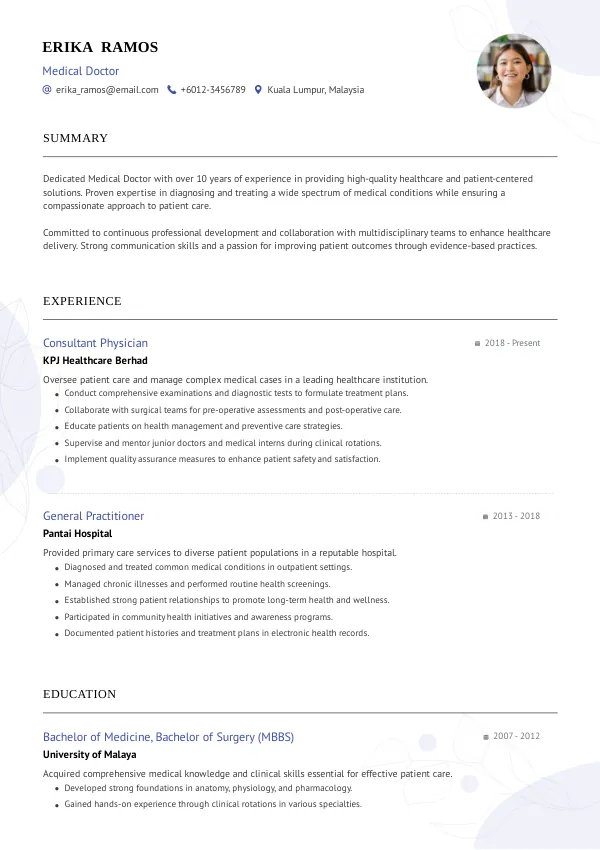
As a medical doctor in Malaysia, your resume is your first impression in a highly competitive job market. Common resume mistakes can significantly reduce your chances of landing an interview.
It's crucial to ensure your resume is polished and free of errors. Consider reviewing your resume with mistakes.cv to catch any potential issues that could be holding you back.
How Recruiters Evaluate Medical Resumes
Recruiters and hiring managers in Malaysia often rely on Applicant Tracking Systems (ATS) to filter resumes. They look for specific skills, qualifications, and experiences that match the job description.
Many candidates fail to notice common oversights in their resumes, which can lead to automatic rejections. A detailed review could reveal these unnoticed issues, making it easier to present a strong application.
Ensure your resume is error-free and well-structured.
Review NowCommon Resume Mistakes for Medical Doctors
Mistake #1 – Poor Formatting
Why this hurts
Inconsistent formatting can make your resume difficult to read. Recruiters may overlook important details if they struggle to navigate your document.
Example
- Bad: Mixed fonts and sizes throughout the resume.
- Better: Uniform font style and size across the entire document.
How to fix
- Choose a clean, professional font and maintain consistent formatting.
Mistake #2 – Generic Objective Statements
Why this hurts
A vague objective statement does not convey your specific goals as a medical professional. Recruiters prefer tailored statements that show your commitment to the role.
Example
- Bad: Seeking a position in healthcare.
- Better: Seeking a junior doctor role to apply my skills in patient care at a reputable hospital.
How to fix
- Craft a personalized objective that aligns with the job you're applying for.
Mistake #3 – Not Including Keywords
Why this hurts
Many doctors overlook industry-specific keywords that ATS software scans for. This can lead to your resume being filtered out before reaching a human reader.
Example
- Bad: Listing experience without relevant medical terminology.
- Better: Incorporating terms like 'patient assessment' and 'clinical skills.'
How to fix
- Review job descriptions to identify relevant keywords and incorporate them into your resume.
Mistake #4 – Lacking Specific Achievements
Why this hurts
Generic duties do not showcase your unique contributions. Recruiters seek candidates who can demonstrate their impact through quantifiable achievements.
Example
- Bad: Responsible for patient care.
- Better: Improved patient recovery rates by 20% through targeted treatment plans.
How to fix
- Highlight specific achievements with numbers and outcomes to illustrate your effectiveness.
Mistake #5 – Omitting Volunteer Experience
Why this hurts
Ignoring volunteer work can downplay your commitment to the medical field and community service. Such experiences can distinguish you from other candidates.
Example
- Bad: No mention of volunteer roles.
- Better: Volunteered in community health camps, providing basic medical assessments.
How to fix
- Include relevant volunteer experiences to showcase your dedication and skills.
Mistake #6 – Including Irrelevant Information
Why this hurts
Including unrelated experiences or information can distract from your qualifications. Recruiters appreciate focused resumes that emphasize relevant skills.
Example
- Bad: Hobbies unrelated to medicine.
- Better: Relevant certifications and advanced training.
How to fix
- Tailor your resume content to highlight experiences and skills pertinent to the medical role.
Mistake #7 – Poor Spelling and Grammar
Why this hurts
Errors in spelling and grammar reflect poorly on your attention to detail, a critical trait for medical professionals. Recruiters may question your professionalism.
Example
- Bad: "Cared for patients with a wide varity of conditions."
- Better: "Cared for patients with a wide variety of conditions."
How to fix
- Proofread your resume multiple times and consider using tools or professional services to check for errors.
Mistake #8 – Failing to Customize for Each Application
Why this hurts
Submitting the same resume for multiple positions may cause you to miss key qualifications the employer is looking for. Customization is vital.
Example
- Bad: Using a generic resume for different job applications.
- Better: Tailoring each resume to highlight the most relevant experiences for each specific role.
How to fix
- Customize your resume for each position based on the job description and requirements.

ATS-Specific Issues in Medical Resumes
ATS systems often struggle with complex formatting, images, or unusual file types. If your resume isn't easily parsed, it may not reach a recruiter.
Common ATS issues include the use of non-standard fonts, excessive graphics, or improper file formats. Identifying and fixing these errors can be challenging without a professional review.
Mistakes Vary by Experience Level
Entry-Level
Entry-level medical professionals often struggle with showcasing relevant clinical rotations or internships. It's essential to highlight these experiences clearly.
Mid-Level
Mid-level doctors may neglect to emphasize leadership roles or specific contributions in their previous positions. Make sure to detail how you have influenced patient care or team dynamics.
Senior / Lead
Senior doctors should focus on strategic impacts and higher-level responsibilities. Highlight your role in policy-making or departmental leadership to demonstrate your value.
Maximize your chances of landing an interview with expert guidance.
Get FeedbackQuick Checklist for Your Medical Resume
- Ensure consistent formatting throughout your resume.
- Personalize your objective statement for each role.
- Include relevant keywords from the job description.
- Highlight specific achievements with quantifiable results.
- Incorporate volunteer experiences that relate to medicine.
- Remove irrelevant information or experiences.
- Proofread for spelling and grammar errors.
- Customize your resume for each job application.
- Use a standard font and format for ATS compatibility.
- Seek a professional review to catch hidden mistakes.
Frequently Asked Questions
What should I include in my medical resume?
Focus on clinical experiences, skills, certifications, and achievements relevant to the position.
How long should my resume be?
A medical resume should typically be 1-2 pages, depending on your experience.
How can I make my resume stand out?
Tailor your resume to highlight unique experiences and results that align with the job description.
Should I include references on my resume?
It's best to state 'References available upon request' instead of listing them on your resume.
How can I ensure my resume passes ATS?
Use standard formatting, avoid images, and incorporate relevant keywords to improve ATS compatibility.
Take Action Now
Your resume is your gateway to opportunities as a medical doctor. Don't let common mistakes hold you back from landing an interview.
Consider reviewing your resume with mistakes.cv to ensure it meets the expectations of recruiters and ATS systems.

 UAE
UAE Qatar
Qatar Saudi Arabia
 South Africa
 Brazil
 USA
USA Canada
 Australia
 United Kingdom
 New Zealand
 Singapore
 Germany
 France
 Spain
Spain Greece
 Italy
Italy India
India Philippines
 Malaysia
 Indonesia
 South Korea
 Japan
Japan