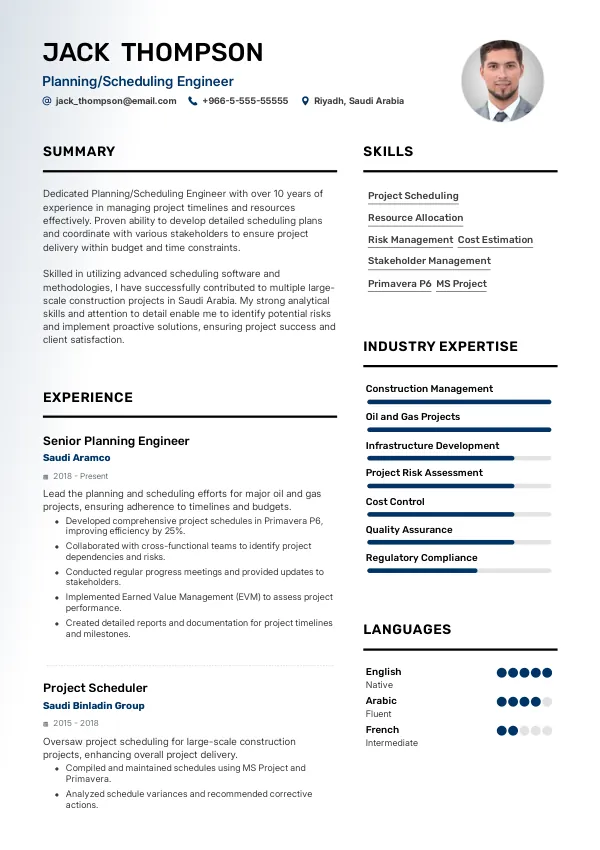
Understanding Resume Mistakes for Planning/Scheduling Engineers
As a Planning/Scheduling Engineer in Saudi Arabia, your resume is your first impression. Common pitfalls can significantly reduce your chances of securing an interview. Many candidates overlook these mistakes, leading to repeated rejections. It's wise to review your resume early to avoid missing out on opportunities.
How Recruiters Evaluate Your Resume
Recruiters and ATS systems focus on structured, clear, and relevant information. They look for specific keywords and formats that indicate a candidate's suitability for the role. Many candidates get rejected for issues that can be easily overlooked without a thorough external review.
Understanding the evaluation process can help you tailor your resume to meet these expectations effectively.
Get expert insights to enhance your resume.
Review NowCommon Resume Mistakes for Planning/Scheduling Engineers
Mistake #1 – Poor Formatting
Why this hurts
Inconsistent formatting can make your resume look unprofessional and hard to read. Recruiters may reject resumes that lack clear structure.
Example
- Bad: Mixed font sizes and styles throughout the document.
- Better: Uniform font size, style, and consistent use of headings.
How to fix
- Use a clean, professional template with consistent formatting.
- Ensure all headings and bullet points are uniform.
Mistake #2 – Lack of Keywords
Why this hurts
ATS systems screen resumes based on keywords relevant to the job description. Missing these can lead to your application being filtered out.
Example
- Bad: Generic phrases like 'good communication skills'.
- Better: Specific terms like 'project scheduling software' and 'resource allocation'.
How to fix
- Carefully analyze the job description for keywords and incorporate them into your resume.
Mistake #3 – Vague Job Descriptions
Why this hurts
Vagueness can lead recruiters to question your actual skills and experience, making it hard to assess your fit for the role.
Example
- Bad: 'Responsible for project management.'
- Better: 'Led a team of 5 in planning and executing a $2 million infrastructure project on time and under budget.'
How to fix
- Provide clear, quantifiable achievements that demonstrate your skills.
Mistake #4 – Ignoring Local Context
Why this hurts
Not considering local industry standards can make your resume less relevant to Saudi Arabian employers.
Example
- Bad: Using international terminologies that are not commonly recognized.
- Better: Adopting terms and jargon familiar to the local engineering market.
How to fix
- Research local engineering practices and ensure your terminology aligns with them.
Mistake #5 – Not Tailoring Your Resume
Why this hurts
Generic resumes fail to highlight your specific qualifications for each job, which can lead to rejection.
Example
- Bad: A one-size-fits-all resume.
- Better: A tailored resume highlighting relevant skills for each application.
How to fix
- Customize your resume for each application, focusing on the most relevant experience and skills.
Mistake #6 – Overloading with Information
Why this hurts
Too much information can overwhelm recruiters, making it difficult for them to find key details.
Example
- Bad: A lengthy resume with excessive details about every job.
- Better: A concise resume that highlights only relevant experience.
How to fix
- Limit your resume to 1-2 pages and focus on key achievements.
Mistake #7 – Omitting Soft Skills
Why this hurts
Technical skills are essential, but soft skills like teamwork and communication are equally vital for Planning/Scheduling Engineers.
Example
- Bad: Listing only technical skills.
- Better: Including both technical and soft skills.
How to fix
- Balance your resume by showcasing both technical expertise and interpersonal skills.
Mistake #8 – Spelling and Grammar Errors
Why this hurts
Errors can signal a lack of attention to detail, which is critical for this role.
Example
- Bad: Typos and grammatical mistakes throughout the resume.
- Better: A polished document free of errors.
How to fix
- Proofread multiple times or have a professional review your resume.


ATS-Specific Issues to Avoid
Many resumes face issues with ATS parsing, which can lead to rejection regardless of qualifications. Common ATS mistakes include using unusual file formats, improper keyword density, and failure to utilize standard headings. These errors are often difficult to spot without an expert review. Consider having your resume checked by mistakes.cv for ATS compatibility.
Mistakes Varying by Experience Level
Entry-Level
Entry-level candidates often struggle with showcasing relevant experience. They may list only academic achievements without practical applications.
Mid-Level
Mid-level professionals might understate their leadership experience or fail to highlight project outcomes, which are critical for progression.
Senior/Lead
Senior candidates should focus on strategic contributions but often include too much technical detail instead of high-level accomplishments.
Ensure your resume meets ATS standards.
Check ATSQuick Checklist Before You Apply
- Use a consistent format throughout your resume.
- Incorporate specific keywords from the job description.
- Avoid vague job descriptions; be specific.
- Tailor your resume for each position.
- Limit your resume length to 1-2 pages.
- Highlight both technical and soft skills.
- Check for spelling and grammar errors.
- Ensure your resume is in a compatible file format.
- Include quantifiable achievements.
- Seek a professional review if unsure.
Frequently Asked Questions
What should I include in my resume as a Planning/Scheduling Engineer?
Focus on technical skills, project experience, and relevant keywords that align with job descriptions.
How important is formatting for my resume?
Formatting is crucial as it affects readability and ATS compatibility. Use clear headings and consistent styles.
Can I use a CV instead of a resume in Saudi Arabia?
While both terms can be used, a resume is more common for job applications in Saudi Arabia.
How often should I update my resume?
Regularly update your resume, especially after completing significant projects or acquiring new skills.
Do I need to tailor my resume for each job application?
Yes, tailoring your resume increases your chances of passing through ATS and impressing recruiters.
Take the Next Step Towards Your Career Success
Don't let simple resume mistakes hinder your career opportunities. Review your resume today to identify potential issues and improve your chances of landing an interview.
Consider using mistakes.cv for a comprehensive review or to check for hidden mistakes that could cost you an opportunity.

 UAE
UAE Qatar
Qatar Saudi Arabia
 South Africa
 Brazil
 USA
USA Canada
 Australia
 United Kingdom
 New Zealand
 Singapore
 Germany
 France
 Spain
Spain Greece
 Italy
Italy India
India Philippines
 Malaysia
 Indonesia
 South Korea
 Japan
Japan