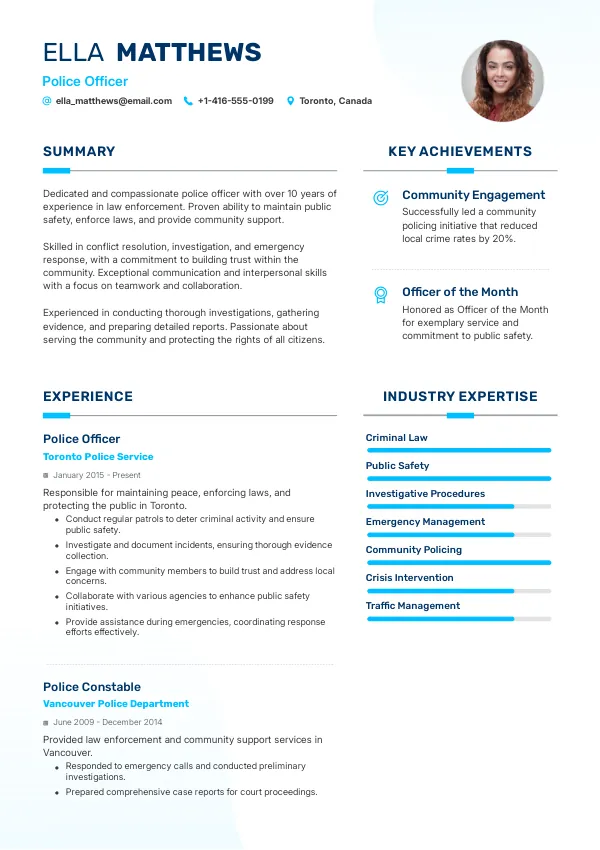
Understanding Police Officer Resume Mistakes
Applying for a police officer position in Canada is competitive, and your resume plays a crucial role in getting noticed. Common mistakes can easily block your path to an interview. Many applicants overlook errors that could cost them opportunities, so it's wise to check your resume for potential issues early on. A thorough review can save you from repeated rejections.
How Recruiters Evaluate Police Officer Resumes
Recruiters in Canada assess police officer resumes for clarity, relevance, and adherence to specific requirements. They often use Applicant Tracking Systems (ATS) to filter candidates based on keywords and formatting. Unfortunately, many candidates are unaware of the common pitfalls that lead to rejection, making an external resume review invaluable.
Such reviews can highlight overlooked mistakes that lead to missed job opportunities in law enforcement.
Get expert tips to enhance your police officer resume.
Learn MoreCommon Resume Mistakes for Police Officer Applicants
Mistake #1 – Poor Formatting
Why this hurts
Recruiters quickly dismiss resumes that are hard to read or poorly organized. Clear formatting is essential in law enforcement where clarity and attention to detail matter.
Example
- Bad: A cluttered resume with inconsistent fonts and sizes.
- Better: A clean, professional layout with consistent formatting and clear headings.
How to fix
- Use a simple, professional font and maintain uniformity throughout your document.
- Utilize bullet points for easy reading and separate sections clearly.
Mistake #2 – Lack of Relevant Keywords
Why this hurts
Without the right keywords, your resume may not pass through ATS filters. Recruiters look for specific terms related to law enforcement skills and experiences.
Example
- Bad: "Worked in community services."
- Better: "Engaged in community policing initiatives to foster public trust."
How to fix
- Incorporate relevant keywords from the job posting, like "community policing," "investigative skills," or "law enforcement protocols."
Mistake #3 – Vague Experience Descriptions
Why this hurts
General descriptions fail to impress recruiters. They want to see specific and measurable achievements that demonstrate your capabilities.
Example
- Bad: "Responsible for patrol duties."
- Better: "Conducted over 200 patrols monthly, leading to a 15% decrease in local crime rates."
How to fix
- Quantify your achievements and provide context to your responsibilities.
- Use action verbs to convey your contributions effectively.
Mistake #4 – Ignoring Job-Specific Skills
Why this hurts
Failing to highlight skills specifically required for a police officer role can lead to rejection. Recruiters look for candidates who possess essential skills for the job.
Example
- Bad: "Good communication skills."
- Better: "Trained in crisis communication and conflict resolution with a focus on de-escalation techniques."
How to fix
- List job-specific skills prominently, ensuring they align with the job description.
- Consider creating a dedicated skills section on your resume.
Mistake #5 – Not Tailoring Your Resume
Why this hurts
Generic resumes are less effective. Tailoring your resume to each specific application shows your genuine interest and understanding of the role.
Example
- Bad: A one-size-fits-all resume sent to multiple departments.
- Better: A resume customized to emphasize skills relevant to the specific police department.
How to fix
- Adjust your resume for every application by aligning your experiences with the job requirements.
- Highlight achievements that resonate with the values of the specific police service.
Mistake #6 – Using an Unprofessional Email Address
Why this hurts
Your email address is part of your professional image. Unprofessional addresses can lead to negative first impressions.
Example
- Bad: "[email protected]"
- Better: "[email protected]"
How to fix
- Create a simple email address that includes your name and is free from nicknames.
Mistake #7 – Neglecting Soft Skills
Why this hurts
Soft skills are crucial for police officers. Ignoring them can make your resume less appealing to recruiters.
Example
- Bad: "Team player."
- Better: "Collaborative team player with demonstrated success in joint operations and community relations."
How to fix
- Incorporate relevant soft skills like communication, teamwork, and adaptability.
- Provide examples of how you applied these skills in past roles.
Mistake #8 – Failing to Highlight Certifications
Why this hurts
Certifications are often mandatory for police positions. Omitting them can lead to immediate disqualification.
Example
- Bad: Not mentioning your police foundations training.
- Better: "Completed Police Foundations Program with a focus on community safety and law enforcement protocols."
How to fix
- Clearly list all relevant certifications, including dates and issuing bodies.


Common ATS Mistakes in Police Officer Resumes
ATS systems are designed to parse resumes effectively, but many candidates make mistakes that lead to rejection. Issues like using non-standard fonts, incorrect file types, or lack of relevant keywords can hinder your chances. These ATS-related errors are often hard to spot without a detailed review. Utilizing a service like mistakes.cv can help identify these pitfalls and improve your resume's chances of passing through ATS filters.
Resume Mistakes by Experience Level
Entry-Level
Entry-level candidates often struggle with showcasing relevant experience. Many overlook internships or volunteer work that demonstrate their commitment to law enforcement. Tailoring resumes to highlight these experiences is crucial for standing out.
Mid-Level
Mid-level applicants may fail to demonstrate leadership skills or specific achievements in past roles. Highlighting promotions and supervisory responsibilities can enhance their appeal.
Senior/Lead
Senior candidates should focus on strategic accomplishments and contributions to organizational goals. Omitting these can make their extensive experience seem irrelevant. It's vital to frame experiences in a way that highlights their leadership and impact.
Identify and correct ATS-related issues in your resume.
Get ReviewedQuick Resume Checklist
- Ensure consistent formatting throughout your resume.
- Incorporate relevant keywords from the job description.
- Quantify achievements and responsibilities.
- Tailor your resume for each application.
- Use a professional email address.
- Highlight both hard and soft skills.
- List all relevant certifications with dates.
- Check for ATS compatibility by using standard fonts.
- Provide context for your experiences and achievements.
- Proofread for spelling and grammar errors.
Frequently Asked Questions
What should I include in my police officer resume?
Your resume should include relevant work experience, skills, certifications, and education tailored to the position.
How can I improve my chances of getting an interview?
Focus on customizing your resume for each job application and highlighting key achievements relevant to law enforcement.
What common mistakes should I avoid?
Avoid vague descriptions, poor formatting, and ignoring keywords specific to the role.
Is it necessary to have a professional review my resume?
Yes, a professional review can help identify mistakes you might overlook and improve your chances significantly.
How can I make my resume ATS-friendly?
Use standard fonts, avoid images, and include relevant keywords to optimize your resume for ATS.
Take Action to Improve Your Resume
Don't let common resume mistakes hold you back from achieving your goal of becoming a police officer. Review your resume for potential issues and make necessary adjustments.
Consider using mistakes.cv for a professional evaluation that can help you secure that crucial interview. Your future in law enforcement starts with a strong resume!

 UAE
UAE Qatar
Qatar Saudi Arabia
 South Africa
 Brazil
 USA
USA Canada
 Australia
 United Kingdom
 New Zealand
 Singapore
 Germany
 France
 Spain
Spain Greece
 Italy
Italy India
India Philippines
 Malaysia
 Indonesia
 South Korea
 Japan
Japan