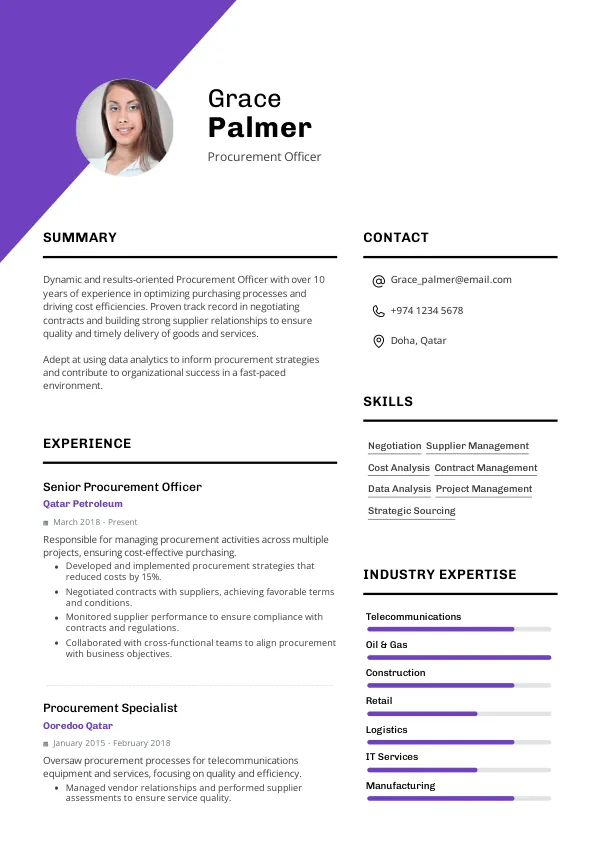
Introduction to Procurement Officer Resumes in Qatar
A procurement officer plays a crucial role in managing an organization's purchasing activities. In Qatar's competitive job market, a well-crafted resume is essential to stand out. However, many job seekers unknowingly make mistakes that hinder their chances of landing interviews. It's wise to review your resume or CV early to avoid common pitfalls and repeated rejections.
How Recruiters Evaluate Resumes for Procurement Officers
Recruiters in Qatar look for specific indicators of competence and suitability when reviewing resumes for procurement officer positions. They utilize Applicant Tracking Systems (ATS) to filter candidates based on keyword relevance and formatting. Many candidates are rejected for issues they never notice, making an external review essential for identifying hidden mistakes.
Understanding the nuances of ATS screening can help you tailor your resume effectively and enhance your chances of being shortlisted.
Identify and fix resume issues to boost your interview chances.
Review NowCommon Resume Mistakes for Procurement Officers
Mistake #1 – Poor Formatting
Why this hurts
A cluttered or inconsistent format can confuse ATS and recruiters alike. It affects readability and makes it hard for your key achievements to stand out.
Example
- Bad: Mixing fonts and sizes throughout the document.
- Better: Using a consistent font and size for all sections.
How to fix
- Choose a clean, professional font and stick to a uniform size for headings and body text.
Mistake #2 – Lack of Keywords
Why this hurts
Failing to include relevant keywords related to procurement can lead to automatic rejection by ATS. Recruiters also look for specific skills that align with their needs.
Example
- Bad: “Managed purchasing.”
- Better: “Managed procurement processes, supplier negotiations, and contract management.”
How to fix
- Research job descriptions and include industry-specific keywords throughout your resume.
Mistake #3 – Unclear Job Titles
Why this hurts
Vague or unconventional job titles can confuse recruiters. They may overlook your experience if they can't quickly understand your previous roles.
Example
- Bad: “Purchasing Ninja.”
- Better: “Procurement Specialist.”
How to fix
- Use standard job titles that accurately reflect your experience and responsibilities.
Mistake #4 – Ignoring Achievements
Why this hurts
Simply listing duties without highlighting achievements can diminish the impact of your resume. Recruiters want to see how you've added value in past roles.
Example
- Bad: “Responsible for vendor management.”
- Better: “Reduced procurement costs by 15% through strategic vendor negotiations.”
How to fix
- Quantify your achievements and focus on the impact you made in previous positions.
Mistake #5 – Not Tailoring Your Resume
Why this hurts
A generic resume can suggest a lack of genuine interest in the position. It may also fail to address the specific needs of the hiring organization.
Example
- Bad: Using the same resume for every job application.
- Better: Customizing your resume to match the job description.
How to fix
- Tailor your resume to each job application by incorporating relevant skills and experiences that align with the role.
Mistake #6 – Excessive Length
Why this hurts
Resumes that are too long can lose the recruiter's interest. A concise resume is more likely to be read in full.
Example
- Bad: A two-page resume filled with unnecessary details.
- Better: A one-page resume that highlights relevant experience and skills.
How to fix
- Keep your resume to one page if you have less than 10 years of experience; two pages are acceptable for more senior roles.
Mistake #7 – Using Jargon or Buzzwords
Why this hurts
Overusing jargon or buzzwords can make your resume sound insincere. Recruiters prefer clear and straightforward language.
Example
- Bad: “Synergized efforts across cross-functional teams.”
- Better: “Collaborated with teams to improve procurement efficiency.”
How to fix
- Use simple, direct language that clearly conveys your skills and experiences.
Mistake #8 – Not Including Relevant Certifications
Why this hurts
Omitting relevant qualifications can lead to missed opportunities. Certifications are important in procurement as they demonstrate expertise.
Example
- Bad: No mention of certifications.
- Better: “Certified Procurement Professional (CPP).”
How to fix
- List relevant certifications clearly, especially those recognized in Qatar's procurement sector.
Common ATS-Specific Issues
ATS systems can misinterpret resumes that don't follow standard conventions. Issues like file type, formatting, and keyword usage can all lead to rejection. Candidates often miss these errors without an expert review. For instance, using complex tables or graphics can confuse ATS, preventing your information from being parsed correctly. Regularly checking your resume for ATS compatibility is crucial for success.
Mistakes by Experience Level
Entry-Level
Entry-level candidates often neglect to emphasize transferable skills. They may also use vague descriptions of internships or academic projects. Be specific about what you learned and the skills you gained.
Mid-Level
Mid-level professionals sometimes fail to showcase leadership experience. They should highlight how they've managed teams or projects effectively. Quantifying achievements is key at this level.
Senior / Lead
Senior candidates may overlook the importance of strategic impact. They should focus on how their decisions have shaped organizational outcomes. Tailoring resumes to reflect seniority is essential for this group.
Get expert insights and eliminate hidden mistakes.
Check ATSQuick Checklist for Your Procurement Officer Resume
- Ensure consistent formatting throughout the document.
- Include relevant keywords from job descriptions.
- Use standard job titles and clear descriptions.
- Highlight measurable achievements.
- Tailor your resume for each application.
- Keep your resume concise and relevant.
- Avoid jargon and buzzwords.
- List all relevant certifications.
- Use standard file formats like PDF or Word.
- Perform a self-review or consider using mistakes.cv for a professional assessment.
Frequently Asked Questions
What should I include in my procurement officer resume?
Focus on relevant experience, skills, and measurable achievements. Tailor your resume to the job description for the best results.
How long should my procurement resume be?
One page is ideal for less than 10 years of experience, while two pages are acceptable for more senior roles.
Are certifications necessary for procurement roles?
Yes, certifications can enhance your credibility and demonstrate your expertise in the field.
How can I improve my resume's ATS compatibility?
Use standard formatting, include relevant keywords, and avoid complex designs that ATS might misinterpret.
What if I'm unsure about my resume's effectiveness?
Consider a professional review with mistakes.cv to gain insights into hidden mistakes and improve your chances.
Take Action on Your Resume Today
Don't let common mistakes hold you back from landing your dream procurement officer position. Review your resume for errors and optimize it for success. Using a service like mistakes.cv can help identify hidden issues and improve your overall presentation.
Take the next step towards securing interviews by refining your resume today!

 UAE
UAE Qatar
Qatar Saudi Arabia
 South Africa
 Brazil
 USA
USA Canada
 Australia
 United Kingdom
 New Zealand
 Singapore
 Germany
 France
 Spain
Spain Greece
 Italy
Italy India
India Philippines
 Malaysia
 Indonesia
 South Korea
 Japan
Japan