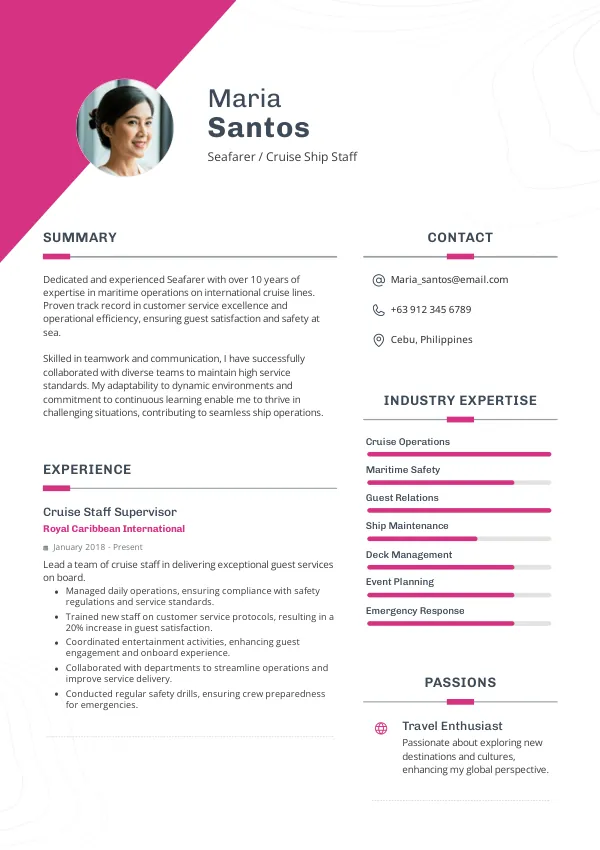
Avoiding Resume Mistakes in the Seafarer Industry
As a seafarer or cruise ship staff member in the Philippines, your resume plays a crucial role in securing interviews. However, many applicants make common mistakes that can lead to rejection. Understanding these pitfalls can significantly enhance your chances of standing out to recruiters. A thorough review of your resume can help you identify and correct these errors before they cost you an opportunity.
How Recruiters Evaluate Seafarer Resumes
Recruiters in the Philippines often use Applicant Tracking Systems (ATS) to screen resumes. They look for specific keywords and formats that match job requirements. Many candidates are unaware of issues that could lead to rejection, such as improper formatting or missing essential information. A professional review can highlight these unnoticed problems and increase your chances of making it through the initial screening.
Review your resume to avoid common pitfalls and improve your chances.
Review NowCommon Resume Mistakes for Seafarers
Mistake #1 – Poor Formatting
Why this hurts
A cluttered or inconsistent format can make your resume hard to read, leading recruiters to quickly dismiss it.
Example
- Bad: A resume with varying font sizes and styles.
- Better: A clean, uniform format with clear headings.
How to fix
- Use a single font type and size throughout your resume.
- Ensure consistent spacing and alignments for better readability.
Mistake #2 – Generic Objective Statement
Why this hurts
Recruiters seek tailored resumes that match the job description. A generic objective fails to demonstrate your interest or fit.
Example
- Bad: "Seeking a position in the maritime industry."
- Better: "Dedicated maritime professional seeking a seafarer position on cruise ships to leverage my navigation skills."
How to fix
- Personalize your objective to reflect the specific position and your relevant skills.
Mistake #3 – Lack of Keywords
Why this hurts
Without relevant keywords, your resume may not pass ATS filters, leading to automatic rejection.
Example
- Bad: "Worked on various ships."
- Better: "Operated navigation equipment on cargo and passenger vessels."
How to fix
- Review job descriptions and include important keywords that relate to the role.
Mistake #4 – Overloading with Technical Jargon
Why this hurts
While some technical details are important, excessive jargon can alienate recruiters unfamiliar with specific terms.
Example
- Bad: "Proficient in all aspects of maritime operations."
- Better: "Skilled in navigation, safety protocols, and emergency response procedures."
How to fix
- Use clear language while still demonstrating your technical expertise.
Mistake #5 – Omitting Relevant Experience
Why this hurts
Failing to list relevant experience can lead recruiters to overlook your qualifications for the role.
Example
- Bad: Listing unrelated work experience only.
- Better: Including all maritime-related roles, even internships.
How to fix
- Highlight all relevant positions, even if they are part-time or volunteer roles.
Mistake #6 – Inaccurate Dates and Information
Why this hurts
Inaccurate timelines can raise red flags about your reliability and attention to detail.
Example
- Bad: "Worked from 2019 to 2021, currently employed."
- Better: "March 2019 - Present."
How to fix
- Double-check all dates and ensure they are accurate and formatted consistently.
Mistake #7 – Ignoring Soft Skills
Why this hurts
Soft skills are critical in the maritime industry, and neglecting them can make your resume less appealing.
Example
- Bad: "Experienced in ship maintenance."
- Better: "Strong team player with excellent communication skills, essential for onboard collaboration."
How to fix
- Incorporate soft skills relevant to the role alongside technical abilities.
Mistake #8 – Not Tailoring Experience for the Job
Why this hurts
Employers look for specific qualifications that match their needs. A one-size-fits-all approach can be detrimental.
Example
- Bad: A resume that lists all experience without context.
- Better: A resume that emphasizes experience related to cruise ship operations.
How to fix
- Adjust your resume for each application, emphasizing relevant skills and experiences.
Avoiding ATS-Related Errors
ATS systems often struggle with improperly formatted resumes, making it crucial to submit documents in compatible formats like .docx or PDF. Many candidates fail to realize that using complex layouts or graphics can lead to misinterpretation of their qualifications. For a successful application, ensure your resume is straightforward and keyword-optimized. Identifying ATS issues can be challenging without expert assistance, so consider using mistakes.cv for a thorough review.
Resume Mistakes by Experience Level
Entry-Level
Entry-level candidates often overlook the importance of relevant coursework or certifications. Highlight any maritime training or internships to demonstrate your commitment.
Mid-Level
Mid-level applicants should focus on showcasing leadership roles and project management experience. Omitting these can make it difficult for employers to assess your fit for advanced positions.
Senior / Lead
For senior roles, failing to demonstrate strategic thinking and mentoring capabilities can hinder your application. Clearly articulate your contributions to team dynamics and decision-making processes.
Get expert insights to ensure your resume is ATS-friendly.
Check ATSQuick Resume Checklist for Seafarers
- Use a clean, consistent format.
- Personalize your objective statement.
- Include relevant keywords from the job post.
- Avoid excessive jargon.
- Highlight all relevant experience.
- Ensure accurate dates and information.
- Incorporate soft skills alongside technical skills.
- Tailor your resume for each application.
- Review for spelling and grammatical errors.
- Save your resume in ATS-friendly formats.
Frequently Asked Questions
What should I include in my seafarer resume?
Include relevant maritime experience, certifications, and skills that relate directly to the job you're applying for.
How important is formatting in my resume?
Proper formatting is essential for readability and ATS compatibility. A well-structured resume significantly improves your chances of being noticed.
Can I use a CV instead of a resume for seafarer jobs?
In the Philippines, resumes are more common for job applications. However, a CV can be used for more academic or specialized positions.
How often should I update my resume?
Regularly update your resume whenever you gain new skills or experiences, especially before applying for a new position.
How can I ensure my resume meets ATS requirements?
To meet ATS requirements, use standard formatting, relevant keywords, and avoid images or complex layouts. Consider a review to identify issues.
Take Action to Improve Your Resume
Don't let small mistakes cost you your dream job on a cruise ship. Review your resume thoroughly, focusing on the common pitfalls mentioned above.
For a more in-depth analysis, consider using mistakes.cv to get a second opinion and ensure your resume is polished and effective.

 UAE
UAE Qatar
Qatar Saudi Arabia
 South Africa
 Brazil
 USA
USA Canada
 Australia
 United Kingdom
 New Zealand
 Singapore
 Germany
 France
 Spain
Spain Greece
 Italy
Italy India
India Philippines
 Malaysia
 Indonesia
 South Korea
 Japan
Japan